Why Is Churchill, Manitoba Famous?
Churchill is famous as the polar bear capital of the world, a beluga whale hotspot, and one of the most reliable northern lights destinations on Earth. Here is why, and how to see it.
A town of about 900 people, per Travel Manitoba's own description, sits on a spit of gravel and muskeg where the Churchill River meets Hudson Bay, more than 1,000 km from Winnipeg with no road connection at all. Yet this settlement is on bucket lists across the world, and it earned that place with three claims almost no other town can make at once. It is called the polar bear capital of the world. It calls itself the beluga whale capital of the world, in Travel Manitoba's wording. And it sits directly under the auroral oval, which makes it one of the most reliable places on the planet to watch the northern lights.
Why Is Churchill Famous?
Churchill is famous as the polar bear capital of the world, a title built on the fact that hundreds of Western Hudson Bay polar bears gather along its coast each October and November while waiting for sea ice to form. It is equally famous for beluga whales that fill the Churchill River estuary in summer, and for northern lights visible most clear nights because the town sits under the auroral oval. If you're planning a trip around any of these seasonal highlights, the season-by-season guide to Churchill's best activities and tours tells you what to do and when.
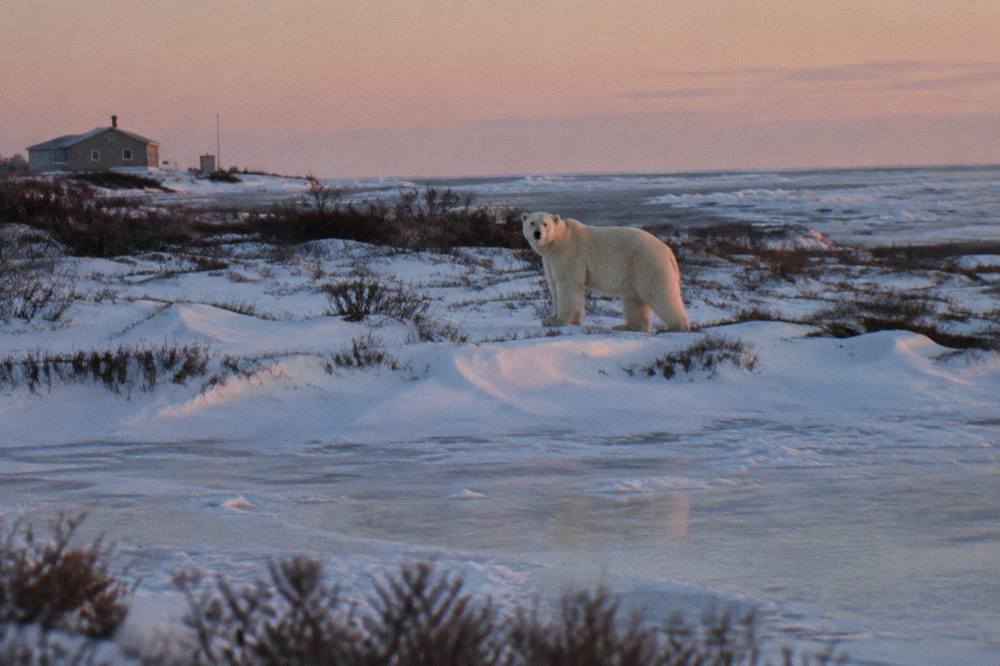
Travel Manitoba puts the fall gathering plainly: from mid-October to mid-November an average of 600 bears roam the Hudson Bay shore waiting for the ice to form. That single sentence explains the town's global reputation better than any marketing campaign could. The bears are not residents of the town; they are migrants forced ashore every summer when Hudson Bay melts, and they must wait, fasting, until the bay refreezes near Churchill at roughly the start of November. The geography funnels them past this one stretch of coast, and the town happens to sit on it.
The fame is layered, though, and each layer has its own season. October and November belong to the bears. Mid-June to mid-September, with July and August the sure window, belongs to the belugas: Travel Manitoba counts over 57,000 whales into Hudson Bay each year, with about 4,000 of those entering the Churchill River estuary. And from late August through April, with February and March the darkest and clearest, the sky takes over. Travel Manitoba claims the lights can appear 300 nights a year in Churchill, a figure worth attributing to them rather than treating as a promise for any given visit. If the whales are what you're chasing, our guide to the best weeks for beluga viewing in Churchill explains how the season builds and which tours operate during it.
Underneath all three sits a fourth story that fewer visitors arrive knowing: a fur-trade fort, a port and a railway town, a Cold War military legacy, and a research community that studies the subarctic year-round. The town's fame is usually told as a wildlife story, but the wildlife only became watchable because people built a railway to this coast and never left.
For most awareness-stage readers, the practical question behind "why is Churchill famous" is really "can I go and see the thing it is famous for." The answer is yes, and the town's small licensed-tour industry exists for exactly that reason. The trio below covers the three most direct ways in: a one-day tundra vehicle tour, a six-day package from Winnipeg, and a summer package built around the belugas.
The Polar Bear Capital Of The World
The polar bear title comes from the fall migration, when an average of 600 bears wait along the Hudson Bay coast near Churchill for sea ice to form so they can resume hunting seals. No other town on Earth has a comparable number of the world's largest land predator walking within viewing distance of its streets for weeks every year.
The mechanism is simple and unforgiving. Polar bears in this region hunt seals from sea ice. When Hudson Bay melts in summer, the bears come ashore and live off stored fat until the bay freezes again. Because the river current and the shape of the coastline make the water near Churchill freeze early, the bears drift toward this stretch of coast as autumn deepens. The Churchill Northern Studies Centre notes that Hudson Bay near Churchill does not refreeze until approximately early November, which means the waiting period lands squarely on the town's doorstep in October.
The town has adapted to its famous neighbours in ways that surprise first-time visitors. Manitoba's Polar Bear Alert Program maintains a controlled zone around the townsite where bears are simply not permitted; officers haze them away with noisemakers, paintballs and rubber bullets first, and capture the persistent ones. Provincial guidance tells residents that if walking is absolutely necessary, they should stay on the main streets of Churchill and never walk in dimly lit areas. Doors around town are often left unlocked so anyone can shelter quickly. A town of about 900 people living alongside a seasonal population of hundreds of bears is the reality behind the postcard.
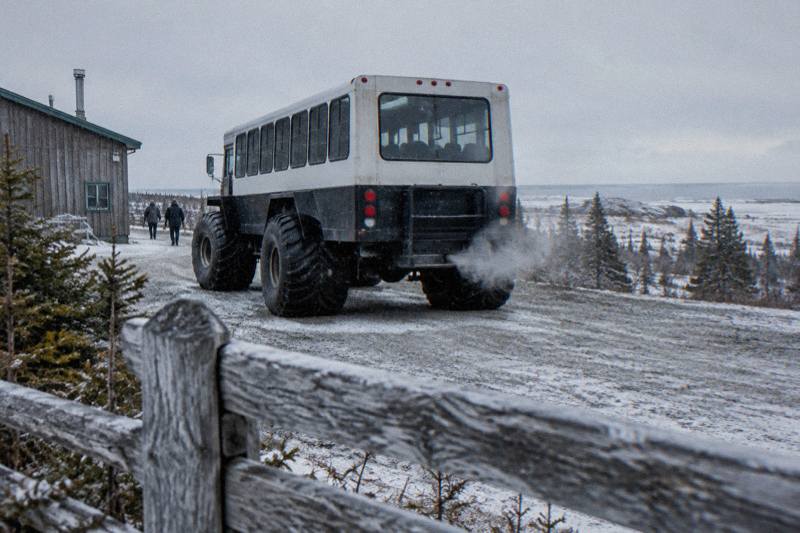
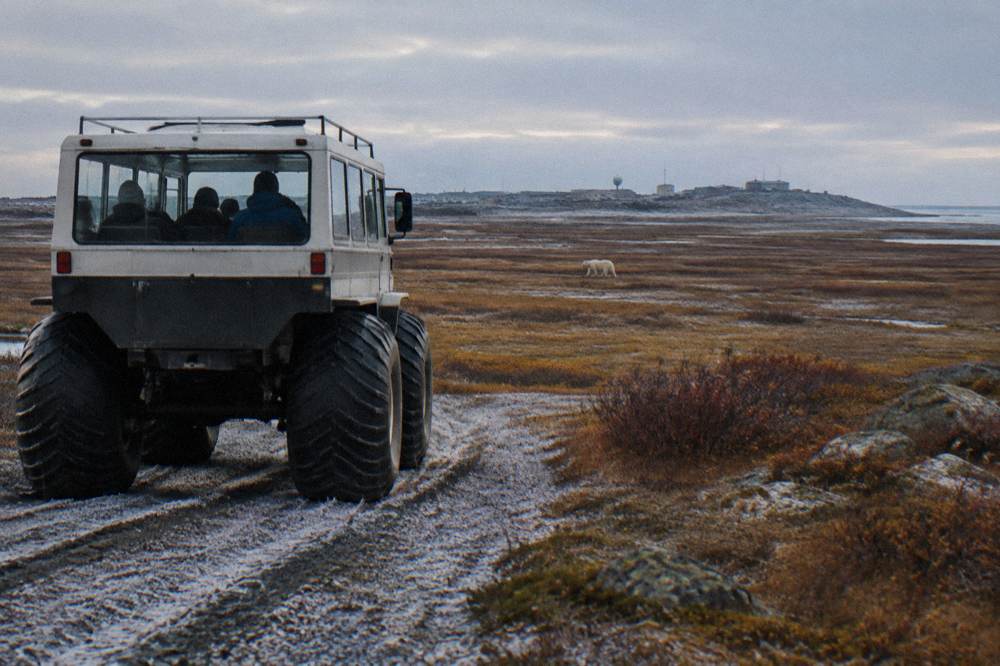
That reality is also why touring is structured the way it is. Viewing happens inside the Churchill Wildlife Management Area under provincial regulation, from licensed vehicles, or inside Wapusk National Park with a licensed operator. The Frontiers North Tundra Buggy, with its 1.7 m tires and elevated rear viewing deck, exists precisely because a raised, licensed vehicle lets people watch bears safely while the bears carry on ignoring them. The eight-hour buggy day with lunch aboard, from $484 per person, is the entry point most first visitors choose, and the six-day Classic Churchill Polar Bear Experience from Winnipeg, from $7,926 per person, is the version that adds flights, town time and several tundra days.
One guest review on the buggy day listing captures what the title means in practice: "We saw more than 15 polar bears and I loved it!" Another, from a Canadian traveller, describes a late-season day that still delivered: "We are in the last week of the season, so I didn't really expect many bears but we struck gold with a mum and her big cub." Those are single days reported by individual guests, not guarantees; bears are wild and every day differs. But the reason those reviews exist at all is the reason the town is famous.
The Beluga Whale Capital Of Hudson Bay
Churchill's second title belongs to summer, when thousands of beluga whales enter the warmer, shallow water of the Churchill River estuary to moult, calve and feed. Travel Manitoba counts about 57,000 whales into Hudson Bay annually, with roughly 4,000 of them entering the estuary itself, which makes the river in July and August one of the densest concentrations of whales accessible by road anywhere.
The belugas arrive between mid-June and mid-September, and July and August are the sure window. They come for the estuary's warmer and shallower water, and they are famously vocal: hydrophones dropped into the river pick up a constant chatter that earned belugas the nickname "sea canaries." From shore at places like Cape Merry, with its historic battery and road access, the white backs of whales surface in the river for hours on end, and no ticket is required to watch from land.
The famous version of the experience is on the water. Local operator Sea North Tours lists zodiac estuary tours of about two hours, kayak tours of about three hours, and combined whale and Fort Prince of Wales trips, all running from June through August pending ice conditions. Snorkelling with belugas, offered by operators in the region, is the experience that travels farthest on social media: floating in a drysuit while curious whales circle below. For readers planning the summer side of Churchill, the beluga whale season guide breaks the timing down month by month.
The summer package on this site's roster is built around exactly this: the Churchill Belugas, Bears and Blooms Adventure, a seven-day Frontiers North itinerary from Winnipeg, from $6,974 per person, rated 5.0 from a small pool of 2 reviews. It pairs the beluga estuary with the summer coast, where Travel Manitoba notes polar bears can still be spotted from July to September in fewer numbers, and with the July and August peak of tundra wildflowers. One trip, all three of the town's famous seasons compressed into a week, is the pitch, and it is a fair one.
What makes the beluga claim genuinely unusual, rather than just marketing, is accessibility. Whale watching elsewhere usually means a boat ride to a spot where whales might appear. In Churchill in August, the whales are in the river beside the town, visible from the shore road, audible through a hydrophone, and numerous enough that a kayak tour is effectively guaranteed company. That density, in a town of about 900 reachable only by train or plane, is the whole story of Churchill's fame in miniature.
Aurora Under The Oval: Churchill's Northern Lights
Churchill's third famous claim is geographic luck: the town sits directly under the auroral oval, the ring of auroral activity centred on the geomagnetic pole, which means northern lights can appear overhead even on nights of low solar activity. Travel Manitoba claims the lights can appear 300 nights a year, with January to March the best viewing season.
Most aurora destinations sit south of the oval, which means they need a strong solar storm to push the lights into their sky. Churchill does not. Under the oval, ordinary geomagnetic activity is enough, which is why Churchill Northern Studies Centre, the research and education facility about 23 km east of town, runs aurora programs through the winter and why photographers treat the town as a training ground. The centre offers an aurora dome and winter learning vacations that combine skywatching with lectures and activities such as dog sledding.
The season runs from late August to April, once the summer's near-continuous daylight fades. February and March offer the clearest and darkest balance of night hours, and the deep cold of those months, with January means around minus 26 C on the long-term normals, comes with famously still, dry inland air. October and November overlap the bear season, which is why several autumn itineraries include an evening aurora watch after a day on the tundra; the overlap is one of Churchill's better-kept advantages.
For travellers whose main goal is the sky rather than the coast, the private aurora night drive on this site's roster is the direct option: a five-hour private car tour from $702 per group of up to five, with hotel pickup and free cancellation up to 24 hours before start. It is a new listing without reviews yet, so there is no rating to cite; what it offers instead is flexibility, chasing clear dark skies outside town with just your group rather than a fixed schedule.
The honest framing, which any reader deserves, is that the aurora is weather-dependent in the ordinary way: clouds hide it, and no operator can promise a display on a given night. What Churchill offers is the best odds, not a certainty. Travel Manitoba's 300-nights figure is their claim about activity, not a promise of visibility, and the town's own winter guides treat patience as part of the experience.
A Fur-Trade Fort, A Railway And A Cold War Port
Before the wildlife fame, Churchill was famous as a fur-trade and shipping point: a Hudson's Bay Company stone fort still stands across the river, a railway and a working grain port turned the settlement into a shipping point, and Cold War military and rocket research facilities left remains that still dot the landscape. The modern town exists because of that chain, not despite it.
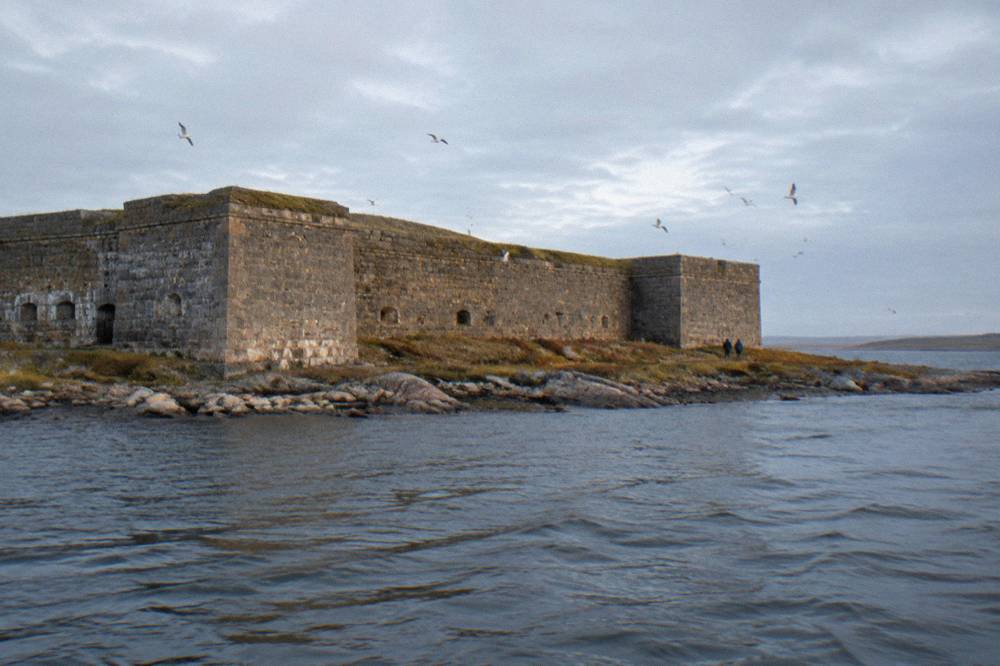
The Prince of Wales Fort, now a Parks Canada national historic site across the river, is a massive stone star fort whose construction stretched across decades of rivalry between the Hudson's Bay Company and the French. It is usually reached by boat, and the Parks Canada Visitor Centre, inside the VIA Rail station, tells its story alongside the region's natural history. The fort is the oldest layer of the town's fame: this river mouth has served as a staging point for centuries. The full index of guides sits on Churchill Polar Bear Tours Canada.
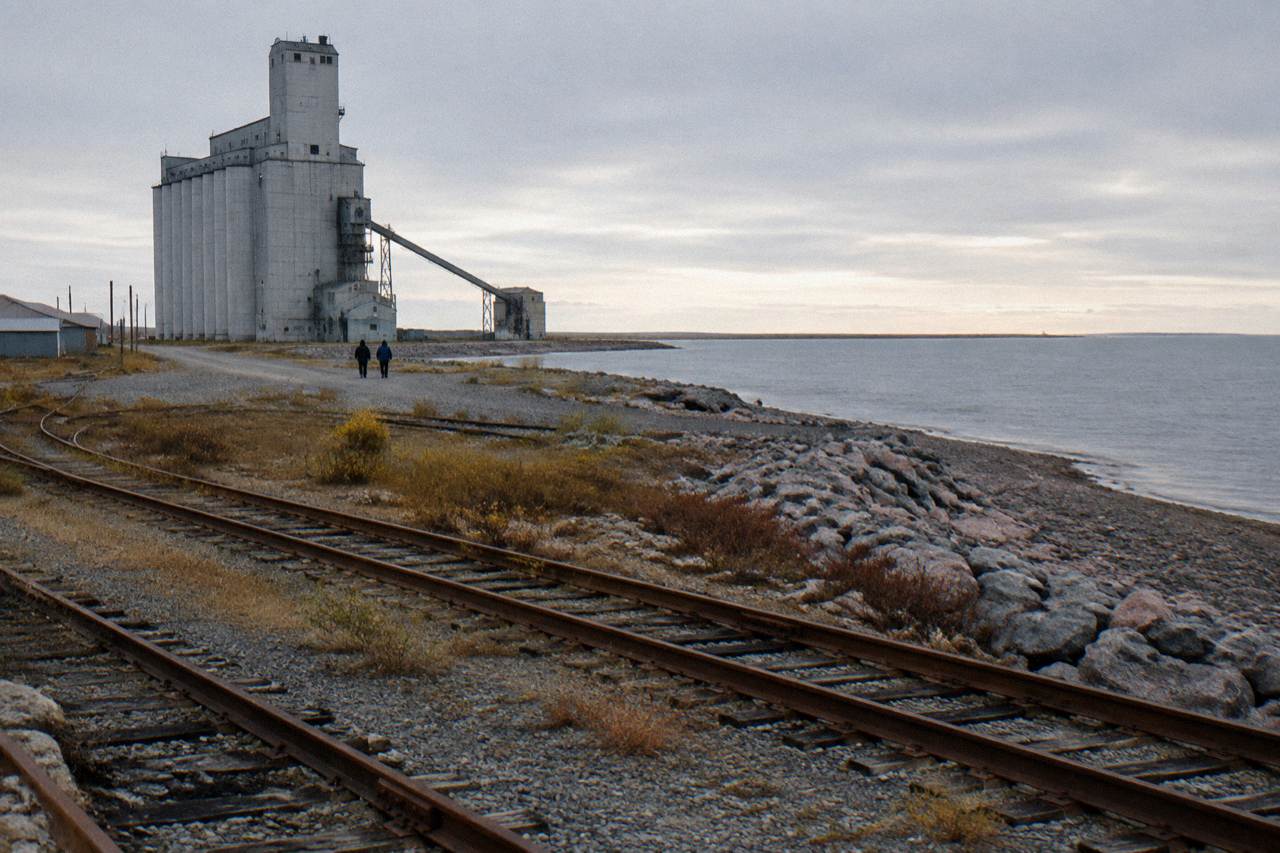
The railway is the layer that made modern Churchill. The Hudson Bay line, now owned by Arctic Gateway Group, was pushed through muskeg and shield bedrock to reach tidewater, and VIA Rail still runs it year-round, twice a week in each direction, taking about 44 hours from Winnipeg. The line was severed by flood damage in 2017 and restored by late 2018, and it remains the only land link the town has. Churchill has no road connection because muskeg, permafrost and bedrock make an all-weather road to the south unfeasible, which is itself a famous bit of Canadian geography. The Winnipeg to Churchill train guide covers the journey in detail.
The military layer came next. Fort Churchill, as the base was known, served through the Second World War and the Cold War, and the Canadian and American rocket ranges east of town launched hundreds of sounding rockets into the upper atmosphere, many of them to study the aurora. That research legacy flowed directly into today's Churchill Northern Studies Centre. So the aurora fame and the military fame are the same story at two ends: the rockets went up to study the lights, and the town that launched them became the town that watches them.
The port still ships grain in occasional seasons, and the town's economy now runs mainly on research and the wildlife tourism that its three titles attract. Walking around Churchill today, a visitor passes a fur-trade fort, a working railway station, a rocket-range legacy and a research centre, all within a few kilometres of the best bear-viewing coast in the Arctic. Very few places pack that into one postcode.
Wapusk National Park And The Subarctic Coast
Wapusk National Park, established in 1996, protects 11,475 square kilometres of tundra, muskeg and coastline east of Churchill, including one of the world's densest known polar bear denning areas. There are no roads into the park; visitors must fly in with a licensed tour operator, and a licensed operator is required for all activities inside it.
The park's name means "white bear" in Cree, which tells the story by itself. Much of the Western Hudson Bay population dens inside Wapusk's inland peatlands, and females emerge with new cubs toward late winter and spring. Access is deliberately restricted: Parks Canada states plainly that a licensed tour operator is required for all activities in the park, that there are no roads in, and that visitors must arrange transportation by aircraft. The rules inside are equally firm: pack out all garbage, no campfires, and never disturb, feed or approach wildlife.
For the awareness-stage reader, what matters is that Wapusk is the protected hinterland behind the famous coast. The bears people watch from a Tundra Buggy in October are the same population that dens in Wapusk through winter, and the park's existence is why the fall gathering near Churchill remains a large, functioning migration rather than a remnant. The 2021 aerial survey's estimate of 618 bears, down from about 842 in 2016, is the reason every operator in town talks about the population carefully and why the licensed-vehicle system in the Churchill Wildlife Management Area matters as much as it does.
The coast itself is worth naming even outside the park boundary. Cape Merry, at the river mouth, offers views, a historic battery and road access, and it is one of the free sights named in recent tourism sources, alongside the Itsanitaq Museum with its Inuit carvings, the Miss Piggy plane-wreck landmark and the Parks Canada Visitor Centre. The Polar Bear Holding Facility near the airport, the "bear jail" of the Alert Program, can be seen from outside only; it is not open to the public inside. A fuller list of no-cost and low-cost stops is in the free things to do in Churchill guide.
How To See Churchill's Famous Wildlife Yourself
The practical answer is a licensed tour: buggy day trips from $484 per person, private road safaris from $1,474 per group, and multi-day packages from Winnipeg from $5,783 per person, all running inside the regulated management area with operators who hold the required permits. Independent bear-viewing is not an option in this region, and the town's own safety guidance makes clear it should not be attempted.
The spread is wide enough to fit most budgets and trip lengths. The table below shows the main options against the three things that usually decide it: price basis, duration and cancellation terms.
| Tour | Price (USD) | Duration | Group | Free cancellation |
|---|---|---|---|---|
| Tundra Buggy Day, Lunch Aboard | from $484 per person | 8 hours | 40-passenger buggy | No, non-refundable |
| Full-Day Guided Tundra Buggy | from $496 per person | 8 hours | 40-passenger buggy | No, non-refundable |
| Private Heated SUV Road Safari | from $1,474 per private group | 8 hours | Private group | Yes, up to 24 hours before |
| Six-Day Package, Dog Sledding | from $7,926 per person | 6 days, 5 nights | Max 22 travelers | No, non-refundable |
| Seven-Day Summer Beluga Package | from $6,974 per person | 7 days | Max 20 travelers | No, non-refundable |
| Six-Day Winter Aurora Package | from $5,783 per person | 6 days | Max 20 travelers | No, non-refundable |
A few patterns are worth spelling out. The buggy day trips are the cheapest per-person route onto the tundra and the only same-day option; the packages add round-trip flights from Winnipeg, which explains most of the price gap, along with a 70 lb (31 kg) total luggage limit split 50 lb checked and 20 lb carry-on. The two private tours are priced per group, not per person, and both list free cancellation up to 24 hours before start, which makes them the flexible choice for travellers still watching the forecast. None of the Frontiers North listings offer free cancellation, so the non-refundable ones deserve a clear-eyed read of the terms before booking.
The private road safari deserves a mention for a specific reason: it is the roster's most flexible format, with pickup from a Churchill hotel, the airport or the railway station, a flexible pace set by the group, and about eight hours of polar bear territory viewpoints and local history. It carries no reviews yet as a new listing, so there is no rating to report, only the terms.
Timing matters as much as format. Travel Manitoba advises planning and booking at least a year in advance for peak October and November, and Frontiers North's own day-tour pages say the Tundra Buggy days tend to sell to capacity. The verified record shows the autumn day tour is on average booked about 180 days ahead. Readers weighing the calendar should start with the best time to see polar bears in Churchill guide, and readers weighing the money should start with the Churchill trip cost breakdown.
One guest on the six-day Classic Churchill Polar Bear Experience, rated 4.8 from 59 reviews, described the trip this way: "This tour was beyond amazing and exceeded expectations! Such a unique experience to see polar bears in their natural habitat and very well organized." Another review from the same listing reads, "Our guide, David, was fantastic, the town of Churchill was welcoming, and the polar bears did not disappoint. I'd highly recommend this to anyone who wants to see polar bears in the wild." Those are two guests' experiences, quoted verbatim, and they reflect what the town's fame delivers when the calendar and the weather line up.
Why The Fame Keeps Growing
Churchill's fame keeps growing because all three of its headline attractions are climate-sensitive and time-limited, which turns a remote town into a priority destination rather than a someday destination. The fall bear gathering depends on sea ice forming, the beluga estuary depends on summer river conditions, and the aurora advantage depends on latitude, so travellers increasingly treat the town as something to see while it is still this reliable.
There is also a plain accessibility story. The town remains hard to reach, more than 1,000 km from Winnipeg by rail or a short flight, and that difficulty is part of the appeal: the famous things in Churchill are not behind turnstiles, they are at the end of a train line. The town's population of about 900, its unlocked doors, its bear alert hotline and its holding facility are all part of a working relationship between a community and its wildlife that visitors find as remarkable as the animals themselves.
For readers who want the full picture of what the town offers beyond the three titles, the things to do in Churchill guide covers the museums, the fort, the coast road and the seasonal activities in one place. And for the question that usually follows the first one, whether a trip is worth the cost and the distance, this site's Churchill worth-it analysis works through the honest answer.
The three tours below are the three ways this site's roster answers the fame: the autumn buggy day for the bears, the six-day package for the full migration, and the summer package for the beluga-and-blooms season. Whichever season draws you, the licensed operators and the regulated management area are what make the town's famous wildlife watchable at all, and booking early is the consistent advice from every source in this record.
Common Questions About Churchill's Fame
Why Is Churchill Famous?
Churchill is famous as the polar bear capital of the world, with an average of 600 bears gathering along its Hudson Bay coast each October and November; as the beluga whale capital of the world, with about 57,000 whales entering Hudson Bay and roughly 4,000 entering the Churchill River estuary each summer; and as one of the most reliable northern lights destinations on Earth because it sits directly under the auroral oval.
How many polar bears are near Churchill?
Travel Manitoba states that from mid-October to mid-November an average of 600 bears roam the Hudson Bay shore waiting for the ice to form. The most recent aerial survey of the Western Hudson Bay population, from late summer 2021, estimated 618 bears, with a statistical interval of 425 to 899, down from about 842 in the 2016 survey.
When can you see beluga whales in Churchill?
Belugas move into the Churchill River estuary between mid-June and mid-September, and July and August are the sure window. Travel Manitoba counts over 57,000 whales into Hudson Bay annually, with about 4,000 entering the estuary, and local operators run zodiac and kayak tours from June through August pending ice conditions.
Can you see the northern lights in Churchill?
Yes, Churchill sits directly under the auroral oval, so lights can appear overhead even at low solar activity. Travel Manitoba claims the lights can appear 300 nights a year, with the best viewing season from January to March, and the broader season runs from late August to April. Displays are weather-dependent and never guaranteed on a given night.
Why is there no road to Churchill?
Muskeg, permafrost and Canadian Shield bedrock make an all-weather road to Churchill unfeasible, so the town is reached only by the VIA Rail Hudson Bay line, about 44 hours from Winnipeg, or by air. The railway, restored after 2017 flood damage, is the town's only land connection.
Is it safe to walk around Churchill?
Yes, with the town's own rules followed. Manitoba's guidance says that if walking is absolutely necessary, stay on the main streets of Churchill and never walk in dimly lit areas. The Polar Bear Alert Program runs a 24-hour hotline at 204-675-2327 during the active season, and doors around town are often left unlocked so anyone can shelter quickly.